Uniting Across Continents for Emergency Medicine: 12-Nation Delegation’s Fruitful Training in China
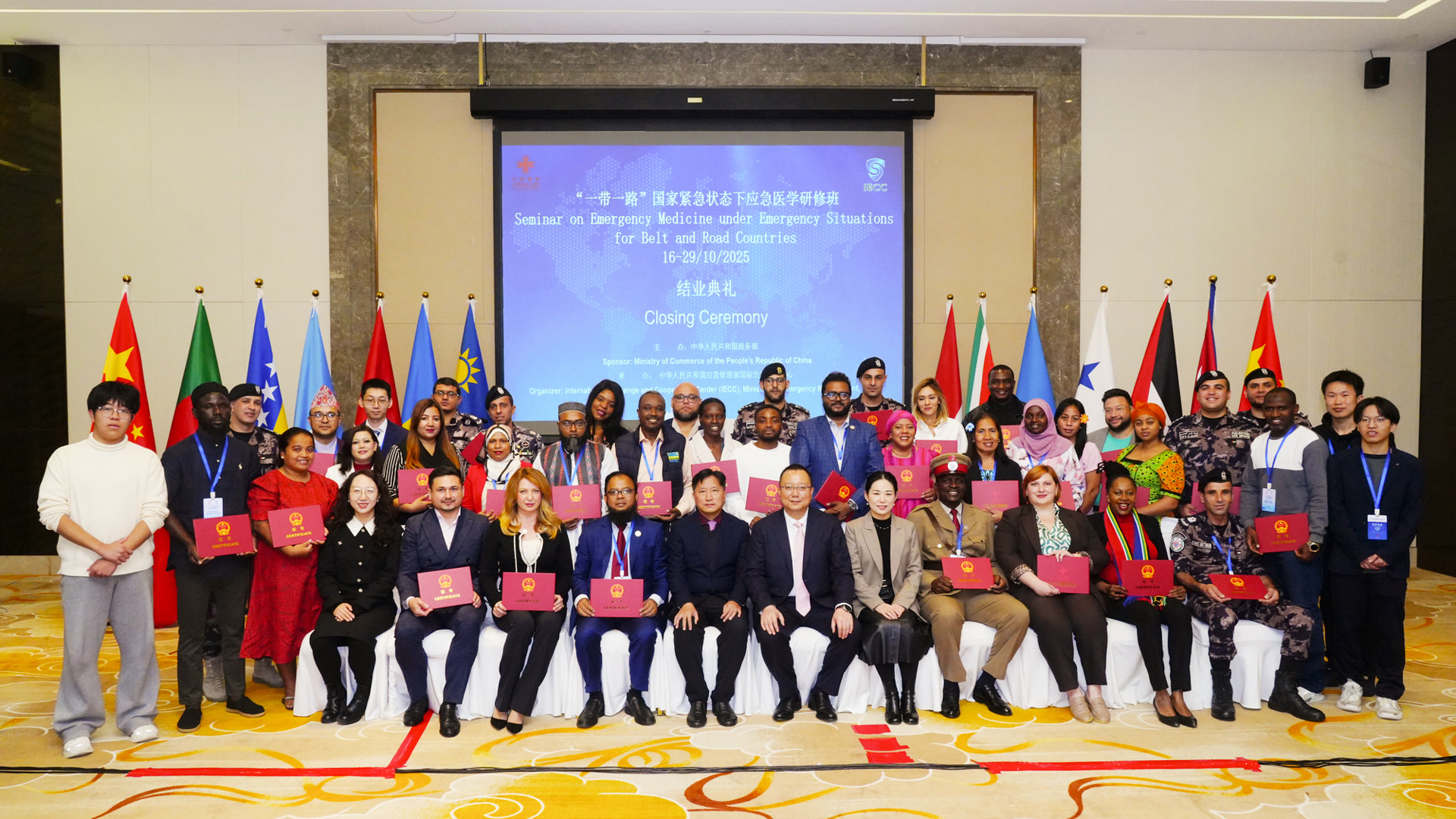
Recently, the "Belt and Road" Emergency Medicine Training Course for National Emergency Response — hosted by the International Exchange and Cooperation Center of the Ministry of Emergency Management and co-organized by the National Research Center for Emergency Medicine (Emergency General Hospital) — was successfully concluded in Beijing. A total of 36 senior officials and experts in emergency medicine from 12 countries, including Bangladesh, Bosnia and Herzegovina, Micronesia, Kiribati, Moldova, Namibia, Nepal, Palestine, Panama, Rwanda, South Africa and The Gambia, successfully completed the 14-day training program in China. Mi Jianying, Deputy Director of the International Exchange and Cooperation Center of the Ministry of Emergency Management, and Liu Zhi, Director of the Emergency Medicine Development Office of the National Research Center for Emergency Medicine, attended the closing ceremony and presented certificates to the participants. During the training workshop, the National Research Center for Emergency Medicine has systematically designed a theory-practice integrated curriculum system focusing on key areas including emergency medical system construction, emergency incident rescue, aeromedical evacuation, and smart healthcare. It has fully demonstrated China’s innovative achievements in cutting-edge emergency medical technologies, community early warning, aeromedical rescue, and smart healthcare. At Beihang University, Professor Liu Hu, Director of the Innovation Research Center for Aeromedical Emergency Rescue, led his team to introduce digital sand table deduction teaching for the first time. By leveraging platforms such as the multi-UAV collaborative mixed reality mission cabin and the joint command seminar hall, the trainees carried out realistic simulation training, which effectively enhanced their capabilities in emergency coordination and command decision-making under complex environments. To fully showcase the achievements of China’s reform and development as well as the progress in the construction of its emergency medical system, the training workshop specially organized the trainees to conduct a field visit to the Shenzhen Base of the National Research Center for Emergency Medicine. The People’s Government of Longgang District, Shenzhen City, attached great importance to this activity; Zhang Yuqing, Deputy District Mayor, attended and delivered a speech at the relevant event. He stated that Longgang District resolutely implements the national deployment, regards the construction of the Shenzhen Base as an important platform for serving national strategies and deepening international cooperation, and looks forward to strengthening experience sharing and practical collaboration with the Belt and Road cooperation partners to jointly improve the regional emergency medical response capacity. Xu Yiqun, Director of the Health Bureau of Longgang District, and Yu Jianbo, Director of the Shenzhen Base of the National Center for Emergency Medical Research and Secretary of the Party Committee of Shenzhen Longgang Central Hospital, accompanied the visit and discussions. During the visit, the trainees of the workshop made an on-site inspection of the Shenzhen Base of the National Center for Emergency Medical Research – namely, Shenzhen No.9 People’s Hospital (Longgang Central Hospital). They observed aeromedical rescue drills on site, and inspected the efficiently operating emergency treatment system, standardized low-altitude rescue procedures, as well as advanced intelligent emergency medical equipment. From the proposal of the concept to practical combat verification, the Shenzhen Base has successfully achieved the normalization of "low-altitude rescue" in a short period of time, and recently completed its first aeromedical rescue mission. This milestone marks the initial completion of the "15-minute emergency rescue circle" in eastern Shenzhen, and this leapfrog development left a profound impression on the trainees. Le Youwei, Director of the Translational Medicine Platform, delivered a special presentation focusing on industry-academia-research collaboration for translational medicine in the medical and engineering fields. The base specially arranged an "Exhibition of Emergency Medical Equipment of Longgang District" for the training workshop. A total of 16 key local medical emergency enterprises including Jingfeng Medical and YHLO Biotech showcased their cutting-edge achievements in intelligent equipment, smart systems, and rescue services. This fully demonstrated the distinct characteristics and strong strength of Longgang’s "integration of healthcare and enterprises, and industrial empowerment", enabling experts from various countries to directly perceive how technological innovation is transformedimmediate combat effectiveness for emergency rescue. The training workshop was praised unanimously by the participants for its substantial content and practical orientation. Frans Mupulua, a participant from Namibia, and Tariq Abu Omar, an official from the Palestinian Civil Defense Authority, delivered speeches on behalf of all trainees at the closing ceremony. They spoke highly of China’s achievements in the field of emergency medicine and stated that they would translate the learning outcomesconcrete practices to advance the development of relevant sectors in their respective countries. "A bosom friend afar brings a distant land near." The National Research Center for Emergency Medicine will actively deepen practical cooperation with countries along the Belt and Road in emergency medicine and humanitarian rescue, and contribute to the development of the international cooperation mechanism for natural disaster prevention and emergency management under the Belt and Road Initiative.